
Afrofuturism
by Michael Wimberly
Temple Mountain Records (TMR)
Release Date: Feb. 19, 2021
Veteran Percussionist and Composer Michael Wimberly Announces New Genre-Crossing Album, Afrofuturism.
This album exhibits the breadth of Wimberly's sonic journey and runs the gamut of musical traditions from Pop, Rock, R&B, Afrobeat, and West African music. Afrofuturism features guest performances and writing by Grammy award-winning singer Joss Stone, Australian Aria award vocalist Gary Pinto, Kora master Foday Muso Susa, producer and guitarist Sharief Hobley, and many others.
Release Date:
February 19th, 2021
by Peter Margasak
A few years ago Michael Wimberly, well known in the jazz world for his sterling work as a bandmate to legendary figures like Charles Gayle and Steve Coleman, visited Gambian kora master Foday Musa Suso at the home of composer Philip Glass, where he stays when he’s in New York. “Mr. Glass was working on composing something, and Foday took me one floor below and began to play the kora for me,” says Wimberly. “I could hear Mr. Glass above me, and Foday in front of me. Needless to say, I was in heaven realizing whom I was listening to and sitting between.” In some ways that experience offers a perfect metaphor for Afrofuturism, his first album as a leader in more than two decades, where he brings a rich variety of musical traditions together under a single roof.
There’s always been more to the game of the veteran percussionist than jazz. His profile isn’t as high as it should be, partly due to his long-running position as a professor at Bennington College, where he was the handpicked successor of the singular Milford Graves in 2012. He’s an inveterate collaborator who’s spent decades working in dance, theater, and film, but a fuller diapason of his artistic vision will finally become apparent with the release of Afrofuturism.
The album reaches far beyond his jazz roots—although there’s no missing the tradition’s extended harmonic language—forging a powerful amalgam of funk, West African music, R&B, gospel, and pop crafted with a kaleidoscopic range of collaborators including Musa Suso (a co-founder of Mandingo Griot Society who’s worked with Herbie Hancock and Bill Laswell), Grammy-winning singer Joss Stone, and drummer Jonathan Joseph (Jeff Beck, Weather Report). He embraces the total music vision coined by the Art Ensemble of Chicago, “ancient to the future.”
While it may be surprising that Wimberly plays mostly keyboards on Afrofuturism, the recording presents his talents as a songwriter and arranger like never before. “I’m a jazz musician, so from my perspective it’s impossible for me to separate it. However, I wanted to package a collection of songs that represent another aspect of my creativity.” Through years of work with the Martha Graham School of Dance, Alvin Ailey American Dance Theatre, and Joffrey II Ballet, to say nothing of creating runway music for iconic fashion designer Donna Karan, he’s developed a seriously holistic conception of the arts, mastering how music both elevates and fits within time-based art.
“Working with dance, theatre, and film directors has taught me how to create music that serves the work, and most importantly, supports the emotional arc of the text or narrative,” says Wimberly. “I use the same approach while improvising. I’m supporting the soloist to help them reach a dramatic arc that they wouldn’t reach without my energy driving them. At the same time, I’m exploring and following the arc of the wave as well. It’s deep listening!” While he wrote a few of the songs years ago—“Madiba,” his homage to Nelson Mandela, was composed a few months before the South African freedom fighter died in 2013, while “Revolution” dates back to the early 1990s—most of the material is of more recent vintage, and all of the material was freshly arranged and conceived for this album.
The seeds for Afrofuturism were planted during a musical pilgrimage to Cuba Wimberly took with his friend and fellow musician and producer Mike Meurin in 2017. “We drank a lot of rum and listened to a lot of music from our archives,” recalls Wimberly. “Mike felt there was an album from some of the demos that I shared. That’s when we began to envision this as a recording project.” Wimberly began to assemble a diverse band to bring his disparate ideas to fruition, drawing from top-shelf session players and masters of traditional African music required by his polystylistic vision.
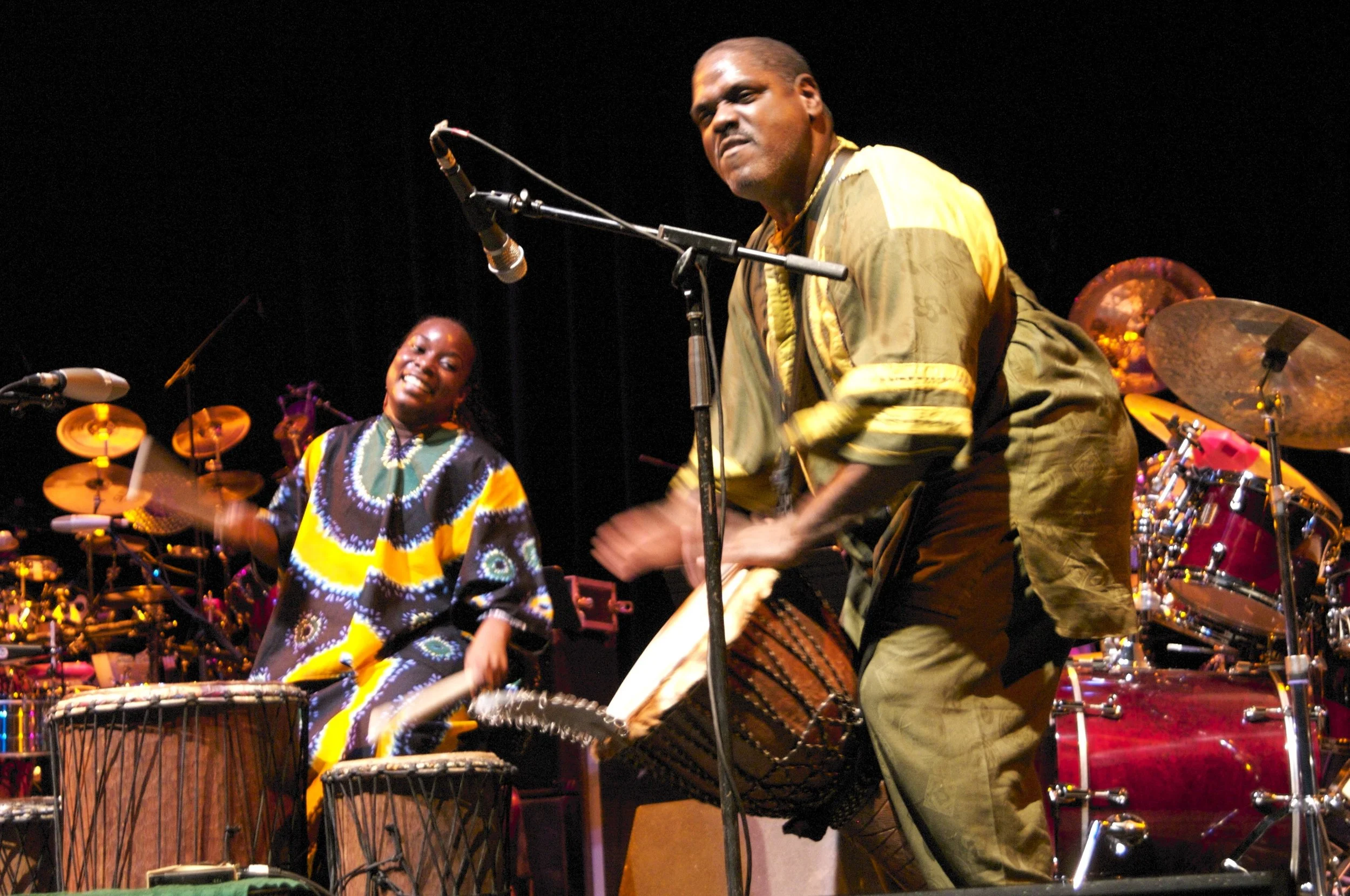
The skittering funk of “Dance With You” blends the cascading kora lines of Musa Suso with the powerhouse singing of Stone, who convincingly takes on the mantle of griot with her earthy delivery, while the deep grooves of songs like “Radio” and “Revolution” reflect Wimberly’s love for classic radio staples like Jimi Hendrix, Prince, and Sly & the Family Stone. Other tunes tap explicitly in West African traditions. “Solei” (traditional)” is percolating marvel distinguished by the liquid balafon playing of Guinean Famoro Dioubate, Wimberly’s agile djembe grooves, and the soulfully husky vocals of Missia Saran Dioubate, while “DDK Groove,” collides the funky bass lines of Trevor Allen and the limber groove of drummer Joseph with Musa Suso’s cycling kora patterns and the leader’s ecstatic djembe propulsion.
“I’m looking to use my music to reflect on legacy while envisioning a future. Ancient to the future – forward thought with deep roots,” says Wimberly. “I’m hoping my music can drive social change, shift perceptions, and transform the way we think. That might be a tall order, but it’s worth striving for.”